The Recordings
The received wisdom among Pumpkins fans is that the Adore era was a misstep. A wrong turn. The album that cost the band its audience, the tour where they played to half-empty theatres instead of full arenas, the period between the glory of Mellon Collie and the attempted comeback of Machina. I have never believed that. I think these were some of the greatest shows the Smashing Pumpkins ever played, and I think the European promotional run in May 1998 is where the evidence sits for anyone willing to listen.
Adore came out on 2 June 1998, but by mid-May the band were already on the road in Europe, playing a run of shows that functioned as both promotional appearances and a tentative test of what the Smashing Pumpkins were supposed to be without Jimmy Chamberlin. The arena-rock machine that had toured Mellon Collie to 4.5 million people was gone. In its place were three people, some drum machines, and a collection of songs about grief, electronic textures, and slow dramatic builds that no one in rock music was doing yet.
Most people who dismiss the Adore tour do so because they assume the shows sounded like the album. They did not. Adore the record is mechanical, precise, controlled. Programmed drums, layered in a studio, every texture placed deliberately. It is a beautiful album but it is a cold one. The live shows were something else entirely. They were visceral, raw, theatrical, and emotionally overwhelming in a way the album never quite allowed itself to be.
The percussion was the key to it. Matt Walker and the touring musicians brought kettle drums, floor toms, a physical weight and ceremony to the rhythms that the album's drum machines could never deliver. When Bullet with Butterfly Wings opened with a percussion solo that built from nothing into something enormous, or when Transmission stretched into its fifteen-minute second half with live drums driving the crescendo rather than a programmed loop, these were not reproductions of studio recordings. They were transformations. The songs grew limbs.
And then there was Corgan at the piano. His mother Martha had died in 1996. He wrote For Martha for her and named it after her, and when he played it live in these small European venues, hunched over the keys, it did not sound like a man performing a song. It sounded like a man trying to communicate with someone who was no longer there; the piano as séance, the venue as chapel, the audience as witnesses to something they had not been invited to but could not look away from. The grief was not abstract. It filled the room. In a 2,000-capacity theatre, with the kettle drums rolling underneath and Corgan's voice cracking on the high notes, you could feel it in the air between the stage and the back wall.
I think this is why the negative reaction to Adore did not stop him touring. He had to play these songs. The album was not a commercial strategy that could be abandoned when the sales figures came in. It was his way of processing the loss of his mother, and the tour was the completion of that process; the songs needed to be played live, in rooms small enough for the grief to reach the walls, before they could do what they were written to do. The Adore studio recordings kept that emotion at a controlled distance, layered behind programming and production. The live shows stripped the buffer away. The electronic precision of the album became something theatrical and primal onstage, and that tension between the controlled studio version and the uncontrolled live performance is what made these shows extraordinary.
Corgan played For Martha 127 times between 1998 and 2000, and twice more as a solo artist, the last time in November 2019 at a small theatre in Springfield, Missouri. He has not played it since. Not on the reunion tours, not on the arena runs, not at any of the shows where the old hits get wheeled out for the crowd. The well is empty. He gave what was in it to the fans who were in those rooms, in those years, and it let him move on. Which means these recordings are not just historical documents. For some of these performances, they are the only way to hear what Corgan was doing with that song, in that period, when the grief was still raw enough to be dangerous.
Listen to the Lisbon recording of Shame, stretched to nearly eleven minutes, all mid-tempo pulse and layered atmospherics building towards a climax that the studio version holds back from, and tell me that is not the blueprint for what Coldplay, Snow Patrol, Keane, Muse, Arcade Fire, and Biffy Clyro would be doing a decade later. The slow-build electronica-rock that defined European alternative music in the mid-2000s; the dramatic, mid-tempo-to-crescendo structures that sold out arenas from 2005 onwards. Billy Corgan got there first, in botanical gardens and art museums, in front of audiences who were not sure what they were hearing.
The problem was not the music. The problem was that this iteration of the Pumpkins was too short-lived, and too consumed by its own internal politics, to own what it had found. D'arcy was being marginalised. Iha and Corgan could barely stand each other. The American audience wanted Bullet with Butterfly Wings and got Crestfallen. Within eighteen months of these European shows, the band would be in the studio making Machina, trying to claw back the rock credibility they thought they had lost, and the Adore experiment would be over. What could have been a reinvention became an interlude. But the recordings from this tour tell a different story, one where Corgan glimpsed a future for guitar-based music that would not fully arrive for another decade, and where a European audience, more attuned to electronica and atmosphere than their American counterparts, was closer to understanding what he was reaching for.
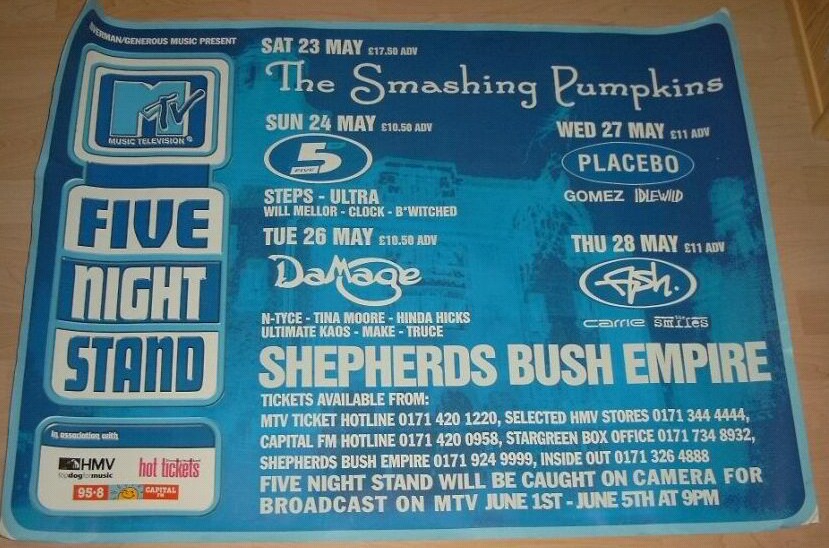
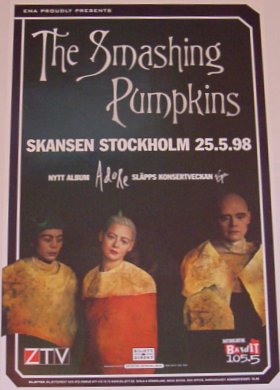
The European leg ran from 14 May in Hamburg to 11 June in Moscow, with stops in Genoa, Cannes, Lisbon, Madrid, Bilbao, London, Stockholm, Copenhagen, Brussels, Dublin, Pinkpop, Paris, Rome, and Athens. Almost every show was either broadcast on radio or television, filmed for promotional purposes, or both. The result is that this four-week stretch is one of the best-documented periods in the band's entire history, with recordings on the Internet Archive across nineteen dates. The tour began before Adore was released and ended with the band playing to a Moscow audience who had to wait while Billy watched the Chicago Bulls in the NBA Finals. In between, the Smashing Pumpkins played on the steps of a fascist-era palace in Rome, in an ancient amphitheatre overlooking Athens, on a rooftop in Paris for fifty people, and in a sports arena for ten thousand on the same day. The venues alone tell you this was not a normal tour.
That density of documentation is part of what makes this leg so valuable to go back to. You are not relying on a single audience recording from the back of a room. For most of these shows, you have FM broadcasts captured to DAT, TV recordings, audience video transfers, and sometimes multiple versions of each. The Lisbon show exists as an FM broadcast transferred through a professional Audiophile 2496 interface. The Shepherd's Bush Empire gig was broadcast on UK television. The Hamburg Spielbudenplatz show was captured from an FM radio feed. When the source material is this good, you can hear things you would never catch from a rough audience tape; the way Corgan's voice cracks on Tear, the electronic undertow beneath Crestfallen, the awkward silence before a song that the crowd does not yet know. And when you listen with hindsight, knowing what European alternative rock would become in the years that followed, the prescience is almost painful.
2 June 1998: Adore Is Released
On 2 June 1998, between Pinkpop and Paris, Adore landed in record shops. It debuted at number two on the Billboard 200 with 174,000 first-week sales, behind Master P. Mellon Collie had debuted at number one with 246,500. The gap was not catastrophic on paper, but in context it was a verdict. Rolling Stone called it "the most intimate album the Pumpkins have ever made and also the prettiest." Pitchfork called it "the Pumpkins' best offering since Siamese Dream." But the praise was qualified, hedged, framed as a defence of something the reviewer expected most people to reject. The fans were less diplomatic. No guitar solos. No Jimmy. All slow songs. Where was Bullet with Butterfly Wings? Where was Zero? Corgan would later go on Howard Stern and say he was "disappointed with our fans," a remark that went down exactly as badly as you would expect.
The single, Ava Adore, is worth pausing on. It is the track that was supposed to introduce the world to the new Pumpkins, and it is curiously out of step with the album it was selling. Ava Adore is aggressive, driven, almost industrial in its attack. It sounds less like Adore and more like a preview of Machina, the record the band would make two years later when they tried to claw back the rock audience they had lost. The rest of Adore is hushed, elegiac, nocturnal. Ava Adore is none of those things. It is a strange choice of lead single for an album of lullabies and electronic grief, and you wonder whether it was a concession to the label, an attempt to reassure people that the Pumpkins could still be loud. If so, it backfired; the single set expectations the album had no intention of meeting, and the listeners who came expecting more Ava Adore got Crestfallen and For Martha instead.
The European tour continued regardless. And the setlists tell you everything about how the band responded to the reception. They did not retreat. Seventy per cent of every post-release setlist was Adore material. No pre-1995 songs appeared at all; no Disarm, no Today, no Rhinoceros. If the critics wanted the old Pumpkins, the old Pumpkins were not coming. The only concession was structural; Bullet with Butterfly Wings stayed in the set, Tonight Tonight stayed, 1979 closed the encores. But the body of every show was Adore, front to back, and if the audience did not want to hear it, that was their problem.
Listening Notes
If you are going to listen to one recording from this leg, make it Lisbon. The audio quality is the best of the lot, the setlist is the deepest, and the performance captures the band at the precise moment of maximum vulnerability; promoting an album that had not yet been released, to audiences who had not yet decided whether to reject it.
If you want the visual story, the Shepherd's Bush TV broadcast is the obvious choice, even with the editorial cuts. If you want to understand what Transmission became on this tour, Copenhagen or Brussels will show you. And if you want to feel the cold, Stockholm.
I keep coming back to how different the band sounds on these recordings. This does not sound like the same band. And it is deliberate. The Mellon Collie Pumpkins were a wall of noise, Jimmy Chamberlin's drums driving everything, layers of guitar stacked to the ceiling. The Adore Pumpkins are three people and some machines, playing in botanical gardens and art museums and old theatres, and the space around the notes is as much a part of the music as the notes themselves. In these shows especially, the newly formed songs are given time to breathe, to let the music inhabit the space without the burden of lyrics. It almost seems like a jazz riff until you start listening to the different shows and the same patterns come up again and again, each time more fully formed, and you realise that the whole thing is in Billy's head. There is no freeform, just the illusion of freeform.
That space was not empty. It was filled with percussion; not the relentless kit drumming of the Mellon Collie era, but something more ceremonial and deliberate. The kettle drums and floor toms gave the Adore material a physical gravity that the album's programming never achieved. On record, Tear is a delicate electronic construction. Live, with those drums underneath it, it became something you felt in your chest. And in that space, Corgan's piano had nowhere to hide. When he sat down to play For Martha in a room of two thousand people, the grief was not a lyrical theme you could read about in a liner note. It was in the room with you. The intimate venues made that possible. An arena would have swallowed it.
Put the Lisbon Shame next to Coldplay's Fix You, released seven years later. Put the Brussels Transmission next to Muse's Absolution-era live recordings. Put the Copenhagen For Martha next to Snow Patrol's Run, or the slow-building crescendos that Biffy Clyro would perfect on Puzzle and Only Revolutions. And put the whole thing next to Arcade Fire, the band that would most fully realise what the Pumpkins were reaching for here. There is a line that runs from Fleetwood Mac through the Smashing Pumpkins to Arcade Fire, and it is this: the mix of male and female, testosterone and delicacy, the tension between voices that changes what a rock band can feel like. The DNA is there. The slow pulse, the electronic textures folded into live performance, the emotional builds that take five or six minutes to reach their peak, the live percussion driving them forward with a weight and drama that no drum machine could replicate. Corgan was writing the grammar of what would become the dominant sound of European alternative rock in the 2000s, and he was doing it in front of audiences of two thousand people who were still processing the fact that there was no Jimmy Chamberlin, without realising that what they were getting instead was something entirely its own.
The consensus among fans and critics has always been that Adore was a retreat, a band diminished by circumstance making diminished music. I think the opposite. I think it was an advance into territory that nobody else in rock music had the nerve or the vision to explore in 1998, and that the bands who would later build their careers on that territory have never fully acknowledged where the path was first cut. The Pumpkins did not lose their way on the Adore tour. They found a future and then, because they were the Pumpkins and self-destruction was always part of the contract, they walked away from it.
Corgan is at his best when he is in crisis. His misery has always been the source of his talent, and in May 1998 his pain is on full display. His personal life is in disarray. The things that had kept him grounded -- his mother, Jimmy Chamberlin, his relationships with his wife, with his bandmates, with his fans -- have all fallen away. He has gone from the world at his feet in the Mellon Collie era to a new period of Billy adrift with no anchor. And it is precisely this that allows his musical ambition to drift unfettered, unmoored from expectation, reaching for something that it has taken half a century for the world to catch up with. These recordings, to our benefit, have captured that period and held it in amber, to be rediscovered by a new generation who will hear in them what the rest of us were too close to recognise at the time.
But there is a second thing, less about the music and more about the man. Corgan needed this tour in a way that had nothing to do with record sales or artistic credibility. His mother had died. He had written an album's worth of songs about it. And the studio versions, as beautiful as they are, kept the pain at arm's length behind layers of production and programming. The tour was where he actually processed it. Night after night, in small rooms, at the piano, with the kettle drums swelling underneath, playing For Martha to a few thousand people who could feel what it was costing him. That is not a promotional tour. That is a man working through something that the album alone could not finish.
He does not play For Martha anymore. He has not played it since 2019, and before that it had largely disappeared from setlists after the original band split in 2000. The song did what it needed to do. He expended it, gave it to the people who were in those rooms, and it let him move on.
I was not one of those people. I have been a Pumpkins fan since 1995 and I did not recognise the brilliance of this period until the brief flame had already gone out. I was waiting for the next Mellon Collie, the same as everyone else, and by the time I understood what the Adore tour had actually been, it was over and the band were tearing themselves apart making Machina. I missed it. I can only live it now through these recordings and my own imagination, listening on headphones to an FM broadcast from a university auditorium in Lisbon twenty-eight years ago and trying to reconstruct what it must have felt like to be in that room when Corgan sat down at the piano.
The remarkable thing is that even at this distance, even through the layers of tape transfer and digital conversion and the crackle of an audience recording from a VHS camera, these shows stand up. They are not just historically interesting. They are musically extraordinary. And that is a testament to something that even die-hard Pumpkins fans do not fully appreciate: that there exists an entire sub-genre of Smashing Pumpkins music that was never captured on a studio album, never released commercially, and survives only in bootlegs and fan recordings buried in the Internet Archive. The live Adore material is not the album played back at you. It is its own body of work; the percussion, the piano, the grief, the theatrical slow-builds, the twenty-minute Transmissions. None of it was recorded in a studio. None of it appears on any official release. If you do not go looking for it in the Archive, you will never know it existed. And if you do go looking, you will find one of the great hidden chapters in the history of alternative rock, preserved by fans with microphones and tape decks who understood, even if the rest of us did not, that something worth keeping was happening in those rooms.
I arrived late. I stayed.
Christopher Dias
20 March 2026